Bikes at the Course
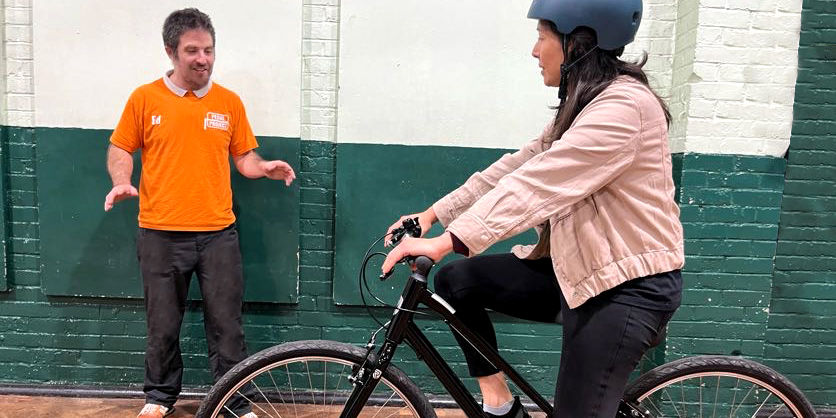
Please do not worry about getting a bike prior to the course as we provide all the bikes at the course.
We use the most suitable bikes for learning - lightweight, simple and a comfortable riding position. We have also made a few adaptations to our bikes to aid the learning process.
We have bikes of all different sizes to fit riders of all heights.
Bike Buying Advice
If you have booked on to the Pedal Project course we guarantee to get you - or whoever you have booked on to the course - cycling safely.
Once you have learnt, it is essential that you are able to practise in the days and weeks immediately following the course. Forget the phrase “it’s like riding a bike” as the skill can easily be lost without practice straight away.
In order to practise, you will need a suitable bike to ride after the course. If you don’t yet have a bike, the best thing to do is wait till the course starts as we’ll be able to give you expert advice on bikes at the end of the first session and we’ll be able to give recommendations on sizing in person.
We sell Ridgeback bikes new and after sizing on the first day of the course, if you would like to purchase one from us, we'll be able to get the right Ridgeback bike ready for you by the end of the course, full assembled and ready to ride! We think Ridgeback is a great brand of bike that is good quality but also good value for a new cyclist.
What makes a good - or bad - bike for a new cyclist?
There is a huge amount of choice when it comes to buying bikes and a very wide range of quality and styles. Here we will set out the different things to consider when looking for a bike as a new cyclist.
Price
We may as well start here! It is possible to get really quite cheap bikes and you can also spend an enormous amount. We will just talk in terms of RRP here, but you will often be able to find large discounts on RRP. During COVID there was a big boom in demand for bikes and a then shortage as a result. Since then there has been an overreaction in the bike market with excess supply, leading to those discounts that are still common today.
The very cheapest bikes sell for around £200. At the upper end there isn't really a limit - some top-end road bikes sell for more than £15k!
For someone who is new to cycling, we wouldn't recommend either extreme!
The very cheapest bikes are often heavy and they are also poor quality, which leads to components failing and the likelihood of spending lots on repairs. We would suggest that £500 RRP is the lower end of what you should consider and you should be able to find a reasonable bike for that amount - fairly light and decent components which should be reliable and durable.
Of course you could spend a fortune on a bike if you can justify it and would like to. But for a first bike, while you are still gaining confidence and finding out what cycling you would like to do, it is probably not a wise investment. It is always an option to get another bike in future!
As a very rough guide, £500-£1000 is what we would recommend spending on a first bike. Of course, you could also look second hand to save some money. More on that below.
Bike styles
There are three basic styles of bike - road bikes, mountain bikes and hybrid bikes. There are some variations and sub-categories within those, but most bikes can be described broadly as one of these three types. We will also mention one other type to avoid (Dutch-style) and one you might consider (e-bikes).
Road bikes
As seen in the Tour de France, these are the fastest type of bike for riding on roads. Typically with narrower tyres, drop handlebars and an aggressive riding position to help with aerodynamics. We wouldn't recommend a road bike as a first bike, mainly because drop handlebars are less intuitive than straight (flat) handlebars, and the aggressive riding position is harder for balance and can be uncomfortable on rides of any distance.
Other sub-categories or variations on the road bike are gravel, touring and endurance bikes. All these variations also have drop handlebars and for that reason we wouldn't recommend them as a first bike.
Mountain bikes
For off-road cycling, these have wider and knobbly tyres for better grip and handling off-road. The handlebars are flat and the riding position is more upright. Mountain bikes often come with suspension for a smoother ride off-road, either just on the front (what is called a hardtail) or on both front and back (full suspension). We wouldn't recommend a mountain bike as a first bike, mainly because you should ride on roads or light trails to start with as you gain confidence. Therefore wide, knobbly tyres and suspension are unnecessary and simply make the bike heavier and slower.
Hybrid bikes
These are bikes for cycling around town and they are a hybrid of road and mountain bikes (hence the name). They have the flat handlebars and upright riding position of a mountain bike but the narrower tyres and lightness of a road bike. We think this is the best of both worlds, and the ideal first bike for a new cyclist. It is the type of bike that will give you a comfortable ride and help build your confidence.
Dutch-style bikes
These are popular mainly due to their aesthetic. We are not fans of Dutch-style bikes for a number of reasons. We mentioned road bikes above as being too aggressive in their riding position. Dutch-style bikes are the other extreme - they typically have high handlebars that are swept back, giving a very upright riding position and the handling can be quite unusual as a result. They are also usually much heavier than hybrid bikes and that, combined with the cumbersome handlebars, can make them very difficult to store or to get in and out of the house or bike shed at the beginning or end of a ride.
E-bikes
These have become much more popular in recent years. You have probably seen takeaway delivery drivers on very fast e-bikes, but these are typically not road legal in the UK. In order to be UK road legal, an e-bike must be pedal-assisted and limited to 15.5 mph (25 kph). I.e. the battery power should cut out if the rider is not pedalling or if the bike is travelling at more than 15.5 mph. You have probably also seen e-bikes for hire - Lime Bikes or Human Forest for example. These are road legal but they are very heavy, and not great quality, perhaps to make them less desirable to steal. Don't be put off e-bikes just because of a bad experience on one of these as they are some of the hardest bike to ride!
Good quality road legal e-bikes are worth looking at, especially if you live somewhere hilly, but as before, we would recommend getting one in a hybrid style. Be aware that an e-bike will be heavier than its standard equivalent, and could be considerably more expensive.
Frame and components - what to look for
Hopefully we have convinced you to get a hybrid bike! Possibly an e-bike version. Here are some more things to consider to narrow it down.
Frame material
For an entry level bike, we'd recommend aluminium for the frame. Aluminium bikes are typically light but not too expensive. Carbon bikes can be lighter still and a bit smoother to ride, but typically much more expensive. At the entry level, steel bikes are typically cheaper but a lot heavier.
Brakes
Disc brakes are much more common on all types of bike now. They are typically better at braking, especially in the wet, but rim brakes are also fine, so don't be put off a bike just because it doesn't have disc brakes.
Gears
As you spend more money, the componentry of the bike gets better. Componentry includes brakes but also gears. With better (more expensive) gears, the shifting will be more reliable and the parts are less likely to need fixing or replacing. One of the main reasons we don't recommend the very cheapest bikes on the market is that it can be very frustrating and ultimately expensive to have bad quality components.
1x (or "one-by") gear systems are more popular now. This is where there is just one chainring for the chain to go round by the pedals and all the gears are at the rear wheel of the bike. This is a simpler and lighter system than also having gears to change at the front (by the pedals). We would recommend this option, although it isn't a dealbreaker.
Brands / colour / design
As the bike market is so competitive, once you have decided on what you are looking for based on everything above - price, bike type, frame material etc. - there will probably be several brands offering a similar solution and all of these are likely to be equally good. You're not going to find a bike by Brand A that is half the price of another very similar bike by Brand B.
So once you have decided what you are looking for, it would be good to choose one that you like the look of! Ignore anyone that teases you for choosing a bike based on its colour, as long as you've considered the things above. It is important that you like the look of the bike, as that will make you enjoy getting out on it more!
Buying new
As we mentioned above, we sell Ridgeback bikes as we think they have a great choice of bikes, including hybrid bikes at a range of price points. If you are interested in getting a Ridgeback bike from us, just wait till the first session of the course and we can advise you on sizing and options at that point. We would then get the bike ready for you to collect at the third session of the course, assuming stock is available.
If you want to look for another brand we will do our best to help as much as we can with that as well. Just be aware that sizing can be a bit tricky from brand to brand as there isn't a universal metric for sizing.
Buying second hand
We mentioned that £500 is a good starting point for a decent first bike. However we realise that this is still a lot of money.
If you would rather spend less than that, it would be definitely worth considering buying second hand. That COVID boom we mentioned has also meant there are a lot of good bikes being sold second hand, by those who discovered they weren't as interested in cycling as COVID made them think!
It is much better to get a better bike second hand than and less good bike new.
There are some things to bear in mind with buying second hand. It is hard to establish the condition of the bike from an advert on ebay, Gumtree, Facebook Marketplace etc. In particular it is hard to know how well the gears are shifting or the brakes are working. So you should factor in that you may need to get the bike serviced after you pick it up. Also delivery of bikes is difficult, so that may be expensive or problematic. Consider a local pick-up. Lastly there are stolen bikes being sold second hand, so watch out for that.
The End
A lot of information! There is quite a lot to consider when buying a first bike. If you are unsure about bikes or have any further questions, do email info@pedalproject.co.uk or wait till the course starts and our instructors will be able to advise at the end of the first session.